
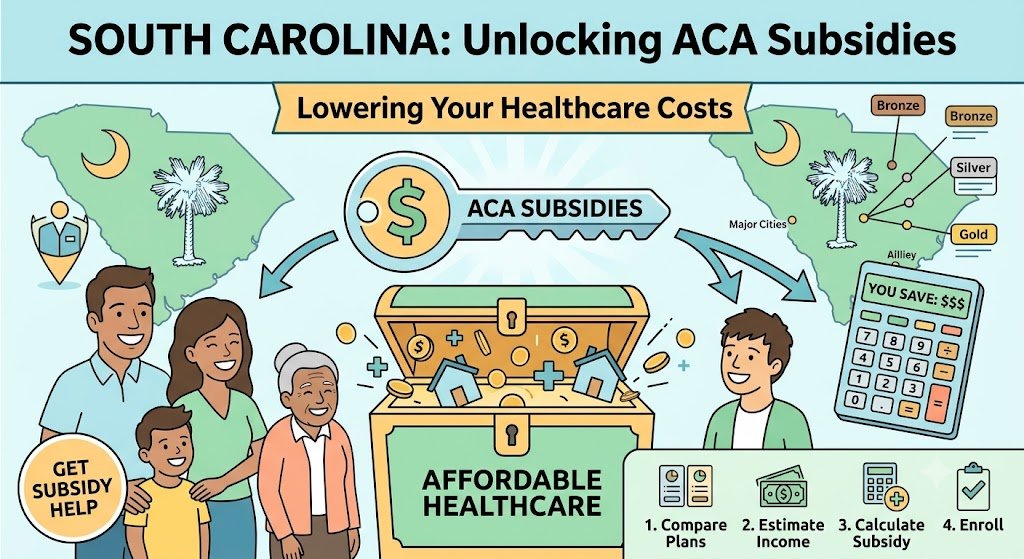
If you buy your own health insurance in the Palmetto State, one question matters more than almost any other: do you qualify for an ACA subsidy in South Carolina? The answer decides whether a plan costs you a few hundred dollars a month or almost nothing — and a lot of people leave real money on the table because they assume they earn too much, or too little, to qualify. Let me clear up how it actually works.
What an ACA Subsidy in South Carolina Actually Is
The subsidy — officially the premium tax credit — is money the federal government applies directly to your monthly health insurance premium when you buy a plan through the Marketplace. It lowers what you pay out of pocket each month. The amount depends mostly on your household income and household size, measured against the federal poverty level.
Here’s the part people miss: it’s not a rebate you wait for at tax time. It’s applied up front, every month, so your premium is lower from day one.
Who Qualifies — and the Myth That Costs People Money
The biggest myth is that subsidies are only for very low earners. That hasn’t been true for years. Middle-income families — including people earning solidly middle-class wages — often qualify for meaningful help, especially with a family to cover.
Eligibility hinges on your estimated annual household income for the coverage year, your family size, and whether you have access to affordable coverage elsewhere (like an employer plan). Because it’s based on estimated income, self-employed people and those with variable earnings have real flexibility — and real reason to get the estimate right.
The Two Ways People Get It Wrong
I see two mistakes constantly. First, people overestimate their income out of caution and miss subsidies they’d have qualified for. Second, they underestimate and owe money back at tax time. Getting the income estimate accurate is where a broker earns their keep — it’s the difference between a pleasant surprise and an unpleasant one.
How the 2026 Rules Affect What You Pay
Subsidy rules and income thresholds are adjusted over time, and the details for the current year matter for your bottom line. The enhanced premium tax credits that had removed the income cap expired at the end of 2025. For 2026, the subsidy cliff is back: the credit slides on a sliding scale up to 400% of the federal poverty level, then stops completely. That cutoff works out to roughly $62,600 for a single person and $128,600 for a family of four — earn a dollar over and the credit drops to zero. The safest move is to have your actual numbers run against this year’s brackets rather than relying on last year’s assumptions or a general rule of thumb.
South Carolina Uses the Federal Marketplace
South Carolina doesn’t run its own state exchange — residents enroll through the federal Marketplace at Healthcare.gov. That means the same federal subsidy rules apply here as in most states, but the plans available, their networks, and their prices are specific to South Carolina and even to your county. Two families with identical income can see different real costs depending on where in the state they live.
When You Can Enroll
Most people enroll during the annual Open Enrollment Period. But if you’ve had a qualifying life event — losing other coverage, moving, marriage, a new baby, a change in income — you may qualify for a Special Enrollment Period and can enroll outside that window. Don’t assume you’ve missed your chance; it’s worth checking.
How I Help South Carolina Families Get This Right
This is exactly where an independent broker saves you money and headaches. I’ll run your actual household numbers against the current subsidy brackets, show you what you truly qualify for, and compare the South Carolina plans available in your county — not a generic quote. There’s no cost to you, and if a subsidized Marketplace plan is your best math, I’ll tell you; if something else fits better, I’ll tell you that too.
You can also learn more about your under-65 coverage options here, or read the official rules at Healthcare.gov.
Not sure what you qualify for? Get a free subsidy check or call me directly at (910) 760-2124.